Celebrating the first-ever National Day of Racial Healing

Seems like an apt annual holiday to instate, doesn’t it?

I collaboratively penned this article about one facet of the puzzle—the role of structural racism in our neighborhoods, and how resident-leaders are turning back its tide—with the wise and wonderful people at ioby.

ioby neighborh vacant lot project

You can get more info about the National Day of Racial Healing, an initiative of the W. K. Kellogg Foundation with support from over 130 other organizations, on its website or with the hashtag .

In freelancing, as in hair metal, what goes around comes around (sometimes)

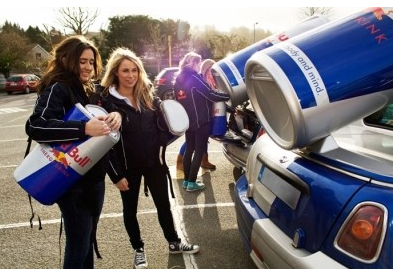
In the thrill-a-minute world of freelance writing (I am only half joking there), clients can come and go as unexpectedly as the Red Bull van that pulls up beside the park and starts handing out free energy drinks. (Or am I the only one who’s witnessed that?)

Red Bull energy drink giveaway

Have you seen me?

This unpredictable ebb and flow can of course be a source of consternation for freelancers, but on balance over the past two-plus years, I’ve found it to be mostly energizing—as well as a good way to practice living in the moment: it’s unwise to become attached to even one’s most cherished clients, as you never know when they might, I don’t know, move to Canada and change their whole business model, or decide that you’ve been so helpful that they now want to hire a full-time person to do what you’ve been doing for them freelance. (Both of those things did indeed happen to me this year.)

While I’ve learned to feel less disappointment when great clients depart, I still feel untempered enthusiasm when they arrive—or, in the cases below, when they re-arrive! (Shoutout to my James Joyce people: both of these clients rearrive[d] from North Armorica. If that means what I think it does, which is debatable.)

Here’s a hearty “hello again!” to:

Sarah Lawrence College

College student in a community garden

SLC student Tenn Joe Lim: “These gardens have taught me about the agency we all have within communal spaces.”

I’ve been working in different capacities with the terrific people at this singular institution since fall 2014 (and boy is my brain getting a workout). Last month, they brought me on as Assistant Editor of their terrific magazine, Sarah Lawrence. I’m super-psyched to keep writing stories for them (like this profile of a student who’s teaching kids in a local community garden), as well as learn more about the inner workings of such a venerable publication.

PLASTARC

Architects

Some of our best and brightest at the Center for Architecture in NYC

It’s plastic (in this case, denoting malleability)! It’s architecture! It’s BOTH!

I met this workplace design consultancy’s ingenious founder Melissa Marsh at the Wood at Work conference last year, and helped her with some one-off writing projects this year. Recently, she’s decided to step up her company’s editorial game and has been showing me the PLASTARC ropes: their monthly newsletter, thoughtful event summaries, and the many guest contributions they make to industry publications. One of my fun gigs this fall was reporting on a public program called, “I Love This Place! Social Research-Driven Design.”

I’m very happy to be embarking on a new year with these two terrific new-ish clients. While I might find the lyrics to some Ratt songs as obscure as lines from Ulysses, I think I know what they mean when they sing:

Round and round
With love we’ll find a way just give it time
Round and round
What comes around goes around
I’ll tell you why
Dig

Yeah?

How I Learned to Stop Worrying and Love My Voice on the Radio

Well, “love” might be too strong a word, but I didn’t mind it—and that’s an improvement!

If you’ve never heard me talk, I suppose you wouldn’t know that I have a fairly deep voice. Sometimes people who called our house when I was growing up thought I was my brother; I was the lone mezzo-alto in the school choir (I come by it honestly—my mom’s a tenor!); and I had an easier time singing R.E.M. in my college dorm shower than I did Tori Amos. Etc.

But out of all the things I was teased about as a kid—wearing thrift store clothes, riding to school on the back of a tandem bike, liking to read!—I was oddly spared any comments about my voice. Which was great! But that didn’t mean I myself was super cool with it.

man playing stand up bass

Did I mention I also played stand-up bass as a kid? (Though probably not as well as this guy.) How appropriate!

Still, I’ve always loved hearing other people’s voices: listening to the radio in particular has long been one of my favorite pastimes. I even aspired for a while to become an on-air DJ, a dream that only went so far as a year of interning at WERS while I was at Emerson College, and (maybe this counts?) a stint of reading books out loud for Recording for the Blind & Dyslexic (which is apparently now called Learning Ally). But I’ve been a proud public radio member-nerd here in NYC for 10 years, and “become an awesome radio DJ” remains somewhere on my to-do list.

Part of the issue, I think, was that I didn’t super-like the sound of my voice when I heard it on tape. I realize most DJs are probably not required to go back and listen to their own recordings after doing a show, but the idea of too many people hearing my low-low tones was perhaps a bit off-putting. Until now!

Enter Ken Kinard, a creativity coach and chief creative officer at the marketing agency Accent Interactive. Ken and I met last spring, during a team-building program he directed for my client Pilot Projects. A few months ago, he told me he was planning to produce a podcast or two about the freelance lifestyle and asked if he might interview me for material. I thought it sounded like a hoot, and hey, maybe it was a chance to see if I’d outgrown my aural awkwardness?

The result of Ken’s and my interesting afternoon conversation at the Housing Works Bookstore Cafe in Manhattan is a two-part ‘cast—also featuring freelancer Meaghan Ritchey of Curator Magazine—that explores the ins and outs of today’s freelance species: what drove us to this marginal existence? how do we manage our time? do we miss having coworkers? Or, the podcast intros themselves put it this way: “As more people are going independent, the way work gets done is changing. We explore how freelancers are living the lives of executives and the impact it has on vacation, family, security, and the community.”

Workwise podcast #10: Nice lance. You free?

Workwise podcast #11: Lancers for the win

Ken’s questions to Meaghan and me are interspersed with reflections from the studio as he and his cohost, Mike Boyes (a leadership development consultant, coach, and president of Credo Consulting), listen to our answers and relate our work experiences to others’. I think (and I’m not biased at all here) that they did a really nice job of asking good questions, representing me (and Meaghan, I would imagine) accurately, and drawing some really interesting insights and further provocations from our conversations.

Plus, I was able to listen to both episodes from stem to stern and not cringe once at the sound of my voice! (Although I notice I did talk pretty fast.) Thanks for whatever magic you wrought there, Ken. Now I’m this much closer to chasing my dream of becoming an awesome radio DJ.

The next time you’re working it in the gym, chopping carrots in the kitchen, or toiling with the toilet brush, perhaps you’ll want to take a listen to these fun shows and let me know what you think? I hope my bass vibrato isn’t too much for your earbuds.

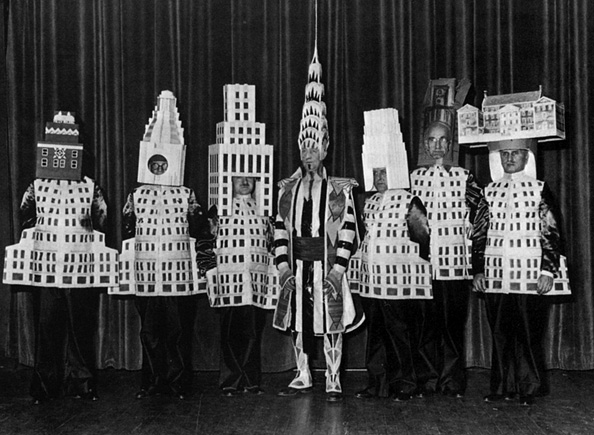
Writing about architecture is like… dancing about music?

People wearing building costumes

I had no idea until this moment that there is a persistent mystery surrounding the origin of that famous quote (which of course I chopped and screwed above).

But whoever originally said it doesn’t really matter for the purposes of this blog post. What matters is that some words I wrote about architecture recently appeared in the American Institute of Architects New York Chapter‘s newsletter!

The Ways and Whys of Incorporating Social Science Methodologies into Architecture Curricula

What does all that mean? You’ll just have to read it to find out!

Many thanks to my very righteous clients Scott Francisco of Pilot Projects and Melissa Marsh of PLASTARC for hooking me up with this fun gig.

Now, let’s dance!

Delicious courage

Although I didn’t attend Sarah Lawrence College, I’m always pleased when people see my byline in their terrific magazine and think I did.

Sarah Lawrence comes out twice a year. It covers all the usual alumni magazine stuff like updates about goings-on at the school and news from notable alums, but blows most other alma mater publications out of the water with its commitment to producing a score of thoughtful stories about fascinating people, places, and projects in every issue.

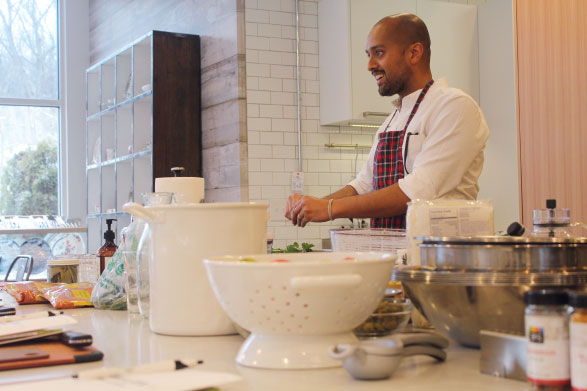
Rohan Kamicheril Tiffin Club

Rohan Kamicheril at work (photo by Mike Jesson)

Take this sampling from their most recent edition, themed “Finding Courage”:

(In addition to presenting you with these opportunities for top-notch reading, I would be remiss if I didn’t shout out the aforementioned chef’s supper club by name. The Tiffin Club pops up periodically with inventive menus, bodacious wine pairings, and excellent camaraderie. Worth your time!)

The Tiffin Club

My hearty thanks to Sarah Lawrence‘s smart and gracious editors, who are wonderful to work with and who somehow keep inviting me back to write stuff. Coming this fall, an interview with a Davis Projects for Peace winner who’s making cardboard furniture with inner city kids!

That fresh “new client” smell

I’ve long been a fan of homesharing upstarts Airbnb. Since 2010, I’ve been renting my place out to fabulous people—packs of Mormon girls from Florida, film students from Korea, and gap year couples from Australia—whenever I go out of town for a spell. And for almost as long, I’ve booked my own one-of-a-kind getaways from Iceland to Budapest to upstate New York using the site. Win-win!

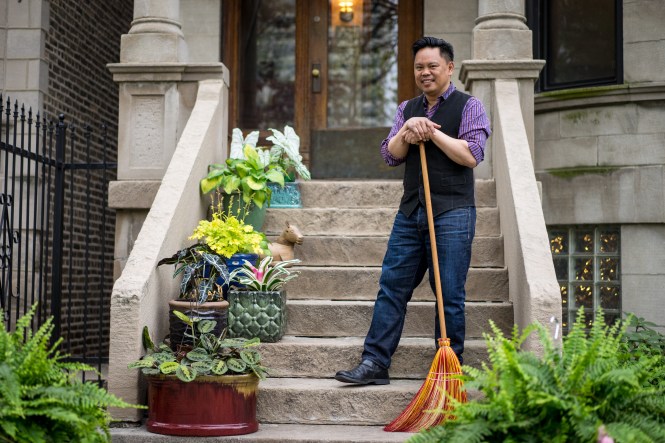
AirBnB host Oliver Aguilar at his home in the Uptown neighborhood of Chicago, IL. May 9, 2016. Photographer: Christopher Dilts / AirBnB

This is Oliver. More about him in a moment. (Photo credit: Christopher Dilts for Airbnb)

As a lifelong hippie, I immediately appreciated the business’s founding premises of extending hospitality to those we don’t yet know, and a waste not/want not approach to space and resources. And as a lifelong Frugal Fannie, I also immediately appreciated the extra income I got from renting.

So you have to imagine I was pretty stoked to start writing for Airbnb recently. They’re growing like crazy, and wanted an extra hand to help publicize the many events they throw and shout their hosts’ stories from the rooftops.

Writing my first few pieces for the site was super fun and brought me back to a basic truth about what I do: attending events, talking with people, and then summarizing the experience in words is one of my very favorite kinds of writing. It’s one of my very favorite things to do, period!

In the past couple of years, my freelance work has taken many directions: narrative writing like this, copywriting for websites, editing papers and reports… I’ve liked it all, but my work with Airbnb has helped illuminate for me that I want to prioritize this kind of people-and-place-based work most of all. It’s entertaining, it’s educational, it’s tactile. And it’s often the easiest type of work I do; the writing and editing usually flows the smoothest. That probably says something in itself.

So thanks, Airbnb, for this breath of fresh editorial air. And thanks to all my fellow hosts—like Oliver, Hans, and Seamus—for being so darn friendly, and so very photogenic!

Getting around, mentally and physically

Like Tupac and The Beach Boys, I get around—with my writing work, that is!

One of the things I love most about freelancing is the unexpected places it takes me, topically and geographically. Last year, I trundled to the Bronx to cover a conference all about wood; wrote about a Taiwanese modern dance company‘s rebound from a devastating loss; and spoke with grassroots leaders in L.A. who are making their streets happier places to walk, bike, and even play—and that was just the beginning!

Pete, Justin, Bikash

Justin (center) with post-earthquake rebuilding partners Pete (left) and Bikash, plus a friendly clothesline

This year, I’m happy to be starting off with a similarly far-flung (to me) gig: an interview with Justin Den Herder, a senior structural engineer at NYC’s Silman Associates, about his experience volunteering for the Pilot Projects initiative Co-Build Kathmandu. Our story ran in the latest volume of cross sections, the magazine of the Structural Engineers Association of New York.

Justin is a smart, fun guy with miles of great stories to tell about his trip. Here’s a sample nugget:

“We wound up purchasing and donating 75, 70-pound bags of rice to people in a small village in Nagarkot,” he said. “One of the most impressive illustrations of Nepalese resiliency I saw during my trip—among many—was the image of old women coming to claim their bag of rice. I’d ask who was there to carry it home for them, and they’d just smile, take the bag from me, throw it over their shoulders, and walk straight up the mountain! I can’t imagine my grandmother doing that. I was struggling trying to lift these bags myself.”

Peep the whole interview here, and let’s give it up for getting around!

Why I might stop calling myself a freelancer

As a wordie (hey, there are foodies, right? why not wordies?), I’m always interested in people’s different reactions to the same word, including my own.

For as long as I can remember, the word “freelancer” has had positive connotations for me. I associate it with independence, bohemia, diverse and interesting work. But when I read my friend and fellow wordie Suzan Bond‘s recent Fast Company article, I experienced something of a change of heart.

20830922855_2fb7fcb6ed_o

Identity! (aka: a windowsill I saw in Prague this summer)

I won’t summarize her story, since Suzan did a marvelous (and concise) job of laying her premise out, but will say I’m starting to think about different ways to introduce myself that wouldn’t be as apt to connote “beginner,” “student,” or “hack” to other people.

I could say…

  • “I provide editorial services to nonprofits and small businesses.” This is exactly true, but rather clunky and perhaps a bit stuffy for a conversational entrée.
  • “I’m a writer/editor.” And then when they ask What do you write?, I say the above.
  • “I’m in business for myself.” “I have my own business.” “I’m self-employed.” Etc. Then the above.

I’m sure something will stick in time. And if “freelancing” has taught me nothing else, it’s that all is fluid! But right now, my curiosity’s piqued.

Fellow self-employed friends: How do you introduce yourselves?

A sci-fi plebe gets initiated

I should have known when I learned that a friend of mine named her blog after a Philip K. Dick novel that she was into science fiction (or should I say speculative fiction? help!), but I really didn’t think about it.

Only several years later (which was already several years after I’d met her) did the topic of sci-fi come up in earnest between us. We were in a rental car on our way to a wedding and she said, apropos of not much, “Have you ever edited a book?”

I said not exactly, but mentioned a few things that kinda-sorta came close. Why was she curious?

“Well, I wrote a sort of sci-fi novel maybe 10 or 15 years ago,” she said, “and it’s basically been sitting in a drawer since then. Recently, I’ve been feeling like I’m ready to do something with it, but I think it could use a second pair of eyes. I’m not sure exactly what an editor would do, besides be a genius and fix all my mistakes… But let me know if you want to talk about it.”

I was SUPER intrigued. For one, my friend wrote a secret book!! For two, it was a sci-fi book—especially weird!! For three, I love me the prospect of a crazy new project.

I’ve found that one of the best things about my first year-and-change of full-time freelancing has been the ability (or heck, sometimes the necessity) to take on a wide variety of editorial gigs. As I heard the author John Vaillant recently say, “I am a professional generalist.” Aside from the thrill of solidarity it gave me to hear a big-name writer identify himself that way—I’ve always been a mega-generalist and sometimes struggled with my lack of speciality, but he’s proof you can have an awesome career as a jack of many interests—his quip also perfectly described one of my favorite job perks: variety.

I told my friend that, although I: a) am not a fiction writer, b) am not even a huge fiction reader, and c) have never, to my recollection, read a sci-fi novel*, I was confident that I could at least do a decent job of copyediting her book, and that if I found I had any developmental suggestions for her in the course of doing so, I’d pass them on. She agreed to hire me, and off I went.

Dune

Dune! Power! Kyle MacLachlan!! (courtesy Flickr user KAZ Vorpal)

I’ve been combing through her formidable 480-page book since the middle of last month, with the goal of finishing by year’s end, and I’m having a blast with it, for many reasons. To name a few:

  • The change of pace is invigorating (see the jollies of the generalist, above). I love what I normally do, which is writing and editing external communications for nonprofits. It’s interesting, it has clear goals, and it’s for a good cause. But fiction! I can crank up the artfulness and shelf for a time the thoughts that the text I’m working on will need to be fact-checked, or instigate a call to action, or fit in a 500-word box. Our only goals here (though they are heady ones) are to tell an engaging story in the most appealing way we can. Hooray for that creative focus and freedom.
  • I’m getting to know my friend better through reading her impressive writing, which is lovely. And I’m probably enjoying reading the story more myself since I know who wrote it. Double win! Oh, and I’m gaining a better understanding of why people like sci-fi. Triple win!
  • As the weather cools, this is the perfect long-form project to curl up on the couch with: blanket over my knees, cup of coffee on the end table, laptop just where it was designed to be. Another nice change of pace: there’s nothing frenetic about this task.

So this post is part shout-out to my talented and industrious friend for believing I might be of some help to her labor of love, part written revelation about the wonderfulness of changing things up at work, and part teaser—’cause this book should be out on Kindle next year and I’ll be engaging in even more shameless self-promotion then!

*   *   *

Hey other freelancers: Do you like the way variety shapes your professional life? (Or maybe you hate it?) Penny for your thoughts in the comments.

*Unless you count a college boyfriend trying to read all of Frank Herbert’s Dune to me in installments. I tried hard to keep up with it, but usually fell asleep before he finished.

More trees, fewer cows = Our best shot at climate change survival

One of my beloved clients is throwing a wonderful conference next Thursday and Friday at the beautiful Bronx Zoo called Wood at Work: Elegant Strategies for Architecture, City-Building, and Forest Conservation. The two-day affair will gather together some of the best minds in architecture, forestry, policy, ecology, and urban planning to talk about how sustainable wood use in cities can actually protect global forests and rural economies and cultures.

2015 Wood at Work conference

In addition to many brilliant presentations and panels, there will be beaucoup de time for informal conversation (and networking) over breakfast, lunch, snacks, and drinks. Plus super fun-sounding workshops like “Japanese Sawing” and “Tree Music”!

I’m not getting paid to say that if you’ll be in New York City and care about a) design or architecture, b) climate change, c) trees and forests, d) native cultures, or e) being in a room packed with brilliant, hard-working, potentially world-saving people, I think you should consider coming. Tickets are pretty cheap, and if you email me, I’ll even send you a magic code for 50% off!

Nice, but what does all of this have to do with cows?, you ask (as you hastily go to the Wood at Work website to purchase a ticket). Perhaps surprisingly, a lot!

As the great Jeremy Radachowsky of the Wildlife Conservation Society explains in a story he just wrote for National Geographic:

Oregon forest by McD22 on Flickr

Flickr’s McD22 captures some Oregonian forest grandeur

There are two existing [climate change-related] technologies that are ready to be acted upon today, whose collective impact could be larger than any future technological breakthrough.

The first technology is a 400-million-year-old solar-powered device that extracts CO2 from the atmosphere and converts it into material useful for construction, essentially “printing” solid materials layer by layer like a 3D printer until a finished product up to 300 feet tall is achieved. Once deployed, the device requires no human input – just water, sunlight, and molecules found in most soils.

This technology is called the “tree.”

A more recent technology extracts tons of carbon already trapped in vegetation and converts it into a small amount of protein-rich food for human consumption. Along the way, large quantities of climate-damaging gasses are emitted. In the moist tropics, the process also requires the clearing of climate-friendly forests and is ten times less efficient than many other methods of food production.

This technology is called the “cow.”

Cows were domesticated by humans more than 10,000 years ago and made sense in the context of a small human population and abundant resources. However, in an era of high population density and climate change, cattle are now an antiquated and obsolete solution to today’s environmental and food security issues. Trees, on the other hand, remain vital to our continued existence.

Makes sense, right? Plus, now that vegan food has gotten so plentiful and delectable, our excuses for massive meat consumption have dwindled to all but nil.

Jeremy’s going to give a talk titled “Trees, Not Cows” on Friday, October 30 at Wood at Work. Come listen with me, then we can share our thoughts over something delicious that’s not beef.